
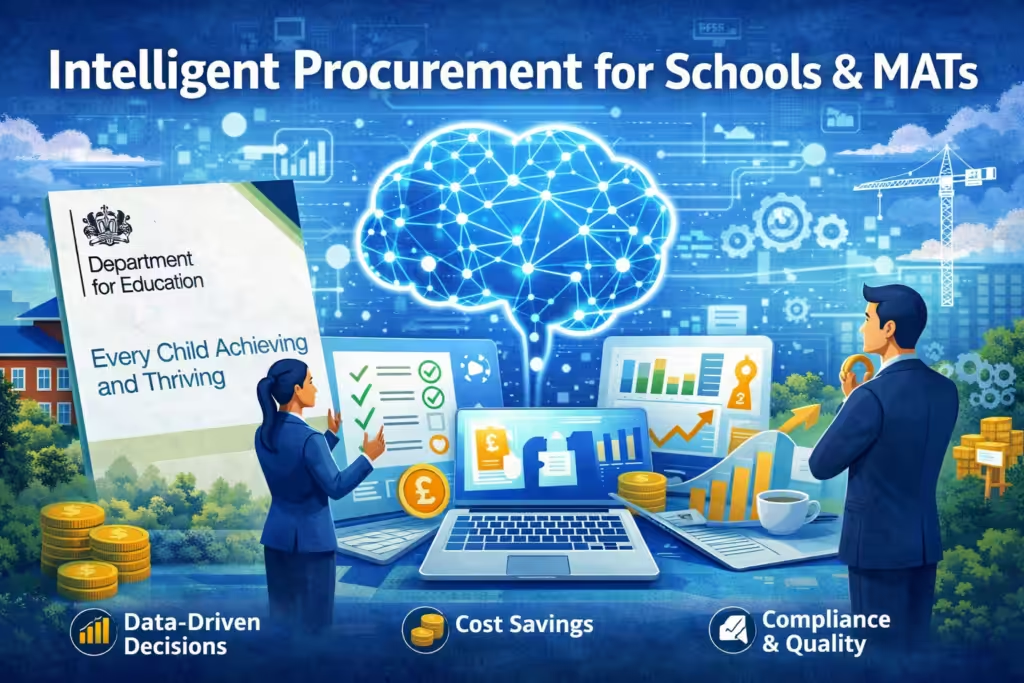
In its recent Schools White Paper, Schools white paper to rewire education transforming life chances – GOV.UK the Department for Education made a clear statement of intent: trusts should be “large enough to optimise benefits”, particularly in educational improvement, estate planning and financial resilience.
While no fixed number of schools has been mandated, the direction of travel is unmistakable. The government is signalling that scale matters, but only where that scale translates into tangible operational and educational advantage. Growth, in and of itself, is not the objective. Structured, disciplined growth is.
This is where procurement becomes central to the debate.
Size Alone Is Not Strength
In practical terms, “large enough” is generally understood to mean a trust with sufficient pupil numbers and school volume to sustain a robust central team. Many sector commentators have historically pointed to trusts in the region of 8–15 schools, or with strong pupil numbers, as being more likely to achieve genuine economies of scale. But size alone guarantees nothing.
A trust can grow quickly and still lack the experience, personnel, systems, visibility and controls required to turn scale into resilience. Without clear procurement frameworks, spend transparency and strong contract oversight, expansion can actually magnify inefficiencies.
Multiple schools operating semi-independently under a shared name will not deliver the financial or strategic advantages policymakers envisage.
To “optimise benefits” requires coordinated systems and disciplined decision-making, particularly around how money is spent.
Procurement as a Strategic Function
In many smaller organisations, procurement is reactive. A contract ends, quotes are sought, and a decision is made. In a mature multi-academy trust, procurement should look very different. It becomes a strategic function aligned to the trust’s educational and financial priorities.
Effective procurement underpins financial resilience by aggregating spend and negotiating from a position of scale. It supports estate planning by enabling longer-term maintenance strategies and structured supplier partnerships. It strengthens educational improvement by ensuring high-quality curriculum resources, technology platforms and professional services are procured consistently across schools.
There are many frameworks available, alongside guidance from the Department for Education, providing useful mechanisms to support compliant purchasing. However, frameworks are tools, not strategies. Trusts must still assess suitability, manage supplier performance and ensure that procurement decisions are driven by long-term value rather than short-term convenience.
The most resilient trusts increasingly adopt a category-based approach to spend, grouping purchasing into defined areas such as ICT, estates, professional services and curriculum resources. This enables forward planning rather than reactive buying. When supported by centralised spend analysis and a live contract register, procurement shifts from being transactional to being strategic.
What Good Procurement Actually Looks Like in a Growing MAT
In a growing trust, good procurement is characterised less by paperwork and more by clarity and foresight.
There is typically a clearly approved procurement policy aligned with the trust’s financial scheme of delegation. Trustees should understand their oversight responsibilities, and executive leaders have defined authority thresholds. Major contracts are visible, reported and monitored rather than buried within individual schools.
Financial discipline is supported by annual spend analysis and benchmarking. Trust leaders know not just how much they are spending, but where aggregation or renegotiation could release savings. Contracts should be managed throughout their lifecycle, with performance indicators agreed at the outset and exit strategies planned before renewal dates approach.
Operationally, standardisation plays a critical role. While individual schools retain identity and flexibility, core services are often aligned to reduce duplication and support efficiency. Supplier onboarding is structured, conflicts of interest are transparently managed, and procurement timelines are planned in advance rather than triggered by crisis.
Ultimately, good procurement in a Multi Academy Trust context is about predictability, transparency and alignment with strategic goals. It reduces volatility and supports long-term planning, exactly the characteristics policymakers associate with “financial resilience.”
Why MIS Procurement Requires Particular Care
Few procurement decisions carry as much operational risk as the selection of a Management Information System. An MIS underpins attendance tracking, safeguarding reporting, census compliance, assessment recording, parental engagement and often finance and HR integration. Changing systems can be disruptive, politically sensitive and resource-intensive.
In a growing trust, inconsistency of MIS platforms across schools can create hidden inefficiencies. Data consolidation becomes more complex, reporting lacks uniformity and central teams must maintain multiple support relationships. Standardising systems across a trust can therefore unlock efficiencies and improve data quality — but only if undertaken through a structured and compliant procurement process.
MIS contracts are also long-term commitments. Headline licence fees rarely reflect total cost of ownership once migration, training, integration and support are factored in. A poorly managed procurement exercise can lock a trust into expensive arrangements for years.
Management Information Systems (MIS) sit at the heart of a trust:
- Attendance monitoring
- Safeguarding reporting
- Census compliance
- Finance integration
- HR data
- Parental communication
Changing MIS platforms is high risk, high cost, and highly disruptive if mismanaged.
In a growing MAT, inconsistent MIS platforms across schools can:
- Increase support costs
- Complicate data consolidation
- Undermine trust-wide reporting
- Limit procurement leverage
Standardising at trust level can generate significant efficiency gains — but only if done with rigorous evaluation and structured procurement.
Please read you considerations document if you’re thinking of changing MIS:
How WhichMIS Supports MATs to Save Time, Money and Risk
This is precisely where WhichMIS adds value. For trusts navigating the complexity of the MIS marketplace, independent procurement support can transform what is often a burdensome internal project into a structured and efficient process.
WhichMIS provides objective market analysis across suppliers, develops detailed requirement specifications and structures compliant competitive exercises. Crucially, the focus extends beyond price comparison to total cost of ownership, contract terms and long-term scalability. Evaluation frameworks ensure stakeholder engagement is meaningful and scoring is defensible, reducing the risk of challenge or audit concern.
For growing MATs, this approach delivers three tangible benefits. Senior leaders save considerable time by avoiding months of vendor-led demonstrations and fragmented information gathering. Financial outcomes are frequently improved because competitive tension is managed professionally. And compliance risk is reduced because procurement is aligned with public sector expectations and best practice governance.
In a policy climate where trusts are expected to be sufficiently large and robust to optimise benefits, using specialist support for high-impact procurements such as MIS is not an indulgence — it is a sensible investment in resilience.
MATs benefit because WhichMIS:
- Provides independent, market-wide analysis of MIS suppliers
- Structures compliant procurement processes
- Develops detailed requirements specifications
- Benchmarks total cost of ownership (not just headline licence fees)
- Supports stakeholder engagement and evaluation scoring
For growing trusts, this delivers three core advantages:
1. Time Saving
Senior leaders avoid spending months navigating vendor claims, demos and documentation.
2. Financial Efficiency
A structured competitive process frequently improves pricing and contract terms.
3. Compliance Assurance
Procurement is conducted in line with public sector expectations and audit standards.
Procurement is conducted in line with public sector expectations and audit standards. In a policy environment where trusts are expected to be “large enough to optimise benefits,” having expert procurement support for critical systems like MIS ensures
Growth Must Be Disciplined
The White Paper signals a system that is increasingly trust-led and structurally consolidated. But the trusts that will truly thrive in that system will not simply be the biggest. They will be the most disciplined.
Scale only becomes strength when it is supported by visibility, governance clarity and professional procurement practice. Trusts that invest in these foundations now will be far better positioned to convert growth into genuine educational and financial advantage — and to demonstrate that they are indeed “large enough to optimise benefits.”