
Why Supplier Contracts Matter More Than Ever
In an increasingly complex EdTech landscape, selecting a Management Information System (MIS) or wider supplier is no longer just about functionality and price. It is about understanding the contractual commitment you are entering into and the long-term implications that may not be immediately visible.
At WhichMIS?, we regularly support schools and MATs who are navigating supplier decisions. A recurring theme is that many challenges arise not from the product itself, but from the contract behind it.
This article explores why careful contract review is essential, highlights key risks to watch for, and reinforces the need for a strong “buyer beware” mindset.
The Hidden Risk: Contracts Are Not All Created Equal
Supplier contracts in the MIS and EdTech space vary significantly. While some are transparent and fair, others contain clauses that can lead to unexpected costs, restricted flexibility, or difficult exits.
Too often, schools:
- Assume contracts are “standard”
- Focus heavily on upfront pricing
- Overlook long-term commitments and conditions
The reality is that small print can carry big consequences.
Key Areas Schools Must Scrutinise
Pricing Structures and Future Cost Increases
Initial pricing can be attractive — sometimes deliberately so. However, schools must look beyond year one and consider:
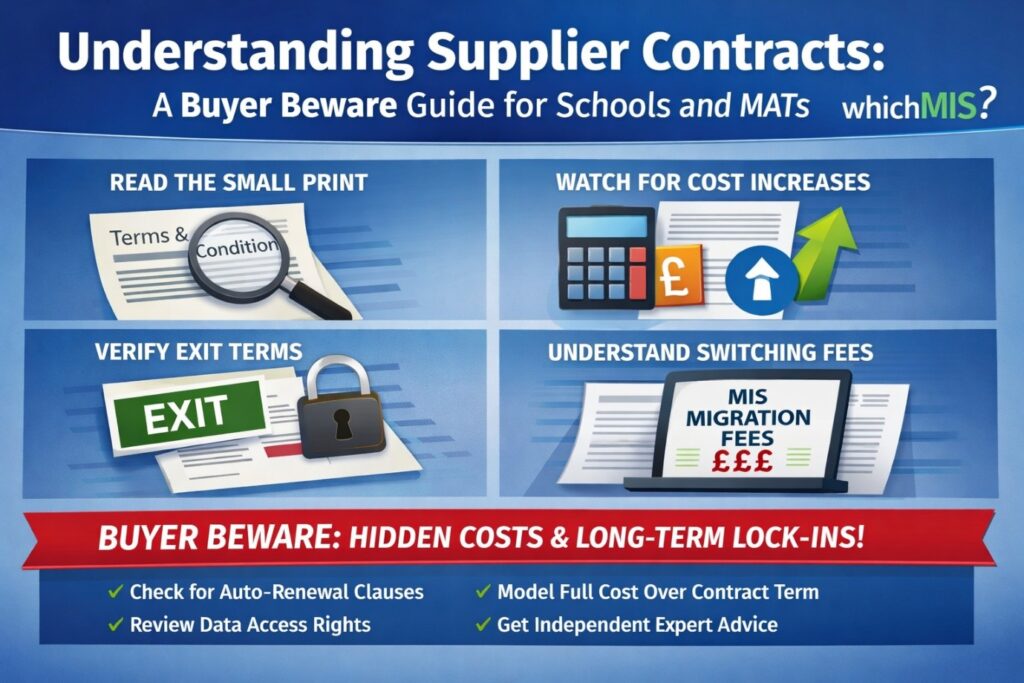
- Annual uplift clauses (e.g. CPI + % increases)
- Tiered pricing based on pupil numbers
- Charges for additional modules or functionality
- “Bundled” services that may become chargeable later
A contract that looks competitive today may become significantly more expensive over a typical 3–5 year lifecycle.
Contract Length and Auto-Renewal Terms
Many MIS contracts include:
- Multi-year minimum terms
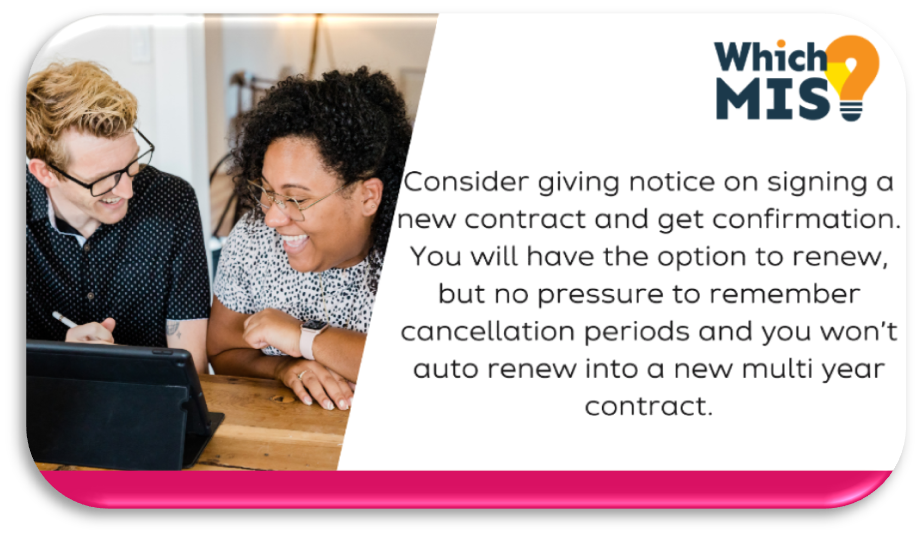
- Automatic renewal clauses
- Strict notice periods (often 3 months +)
Missing a notice window can lock a school into another full contract cycle, even if they are unhappy or planning to change systems.
Exit Terms and Data Access
One of the most critical — and often overlooked — elements is what happens when you leave.
Schools should carefully review:
- Data extraction rights and formats
- Charges for data exports
- Time limits for accessing your data post-contract
- Support provided during transition
Your data is your asset — but contracts don’t always make it easy to retrieve or use.
The Real Cost of Switching MIS
A growing concern across the sector is the range of charges some suppliers apply when a school decides to leave.
These can include:
- Data extraction fees
- Migration support costs
- Charges for historical data access
- Early termination penalties
- Consultancy or “offboarding” fees
In some cases, these costs can run into thousands of pounds, creating a financial barrier to change — even when switching is in the school’s best interest. This is where the principle of “buyer beware” is particularly important. The cost of leaving should be understood before signing, not discovered at the point of exit.
Third-Party Supplier Charges – An Emerging Concern
An increasingly contentious issue is the role of third-party EdTech providers when a school changes its MIS.
Many schools now rely on a wide ecosystem of integrated systems — payments, communications, safeguarding, catering, and more. When an MIS change occurs, these providers are often required to make minor adjustments, such as reconfiguring integrations or updating APIs.
However, we are seeing a growing number of cases where third-party suppliers are charging schools significant fees for this — often £500 or more per system.
While some providers take a pragmatic and supportive approach, recognising the limited effort involved, others are taking a far more rigid stance — insisting on full charges regardless of the actual work required.
From our perspective, this raises serious concerns:
• In some cases, the level of effort does not justify the cost
• Charges are not always transparent or clearly communicated upfront
• Schools are effectively penalised for making a legitimate strategic change
• Costs can quickly escalate when multiple systems are involved
It’s also important to appreciate that in some cases it can take a few days for suppliers to catch up with your changes.
Therefore, you may have to manage without that third-party system for the first few days of your new MIS…

What should schools do?
• Ask all third-party providers upfront about MIS switching charges
• Build these potential costs into your total cost of change model
• Challenge fees that do not reflect actual effort
• Seek suppliers who demonstrate flexibility and partnership
As the EdTech ecosystem becomes more interconnected, this is an area that demands far greater transparency and, arguably, sector-wide scrutiny.
Service Levels and Support Commitments
Contracts should clearly define:
• Response and resolution times
• Support availability (term-time vs year-round)
• Escalation processes
Without this clarity, schools may find themselves paying for a service that does not meet expectations, with limited recourse.
Contract Trends Schools Should Be Aware Of
Across the MIS and EdTech market, we are seeing several notable trends:
• Shift to SaaS models with recurring subscription pricing
• Increased use of auto-renewal clauses
• More suppliers introducing exit-related charges
• Greater complexity in pricing structures
• Bundling of services that may reduce transparency
While these trends are not inherently negative, they do require greater diligence from buyers.
Why “Buyer Beware” Has Never Been More Important
Schools and MATs are operating under increasing financial pressure. Every procurement decision must deliver value — not just at the point of purchase, but throughout the contract lifecycle.
A robust approach should include:
• Reading the full contract — not just the summary
• Asking suppliers to clarify ambiguous clauses
• Modelling total cost over the full term
• Understanding exit implications before signing
• Seeking independent advice where needed
Final Thoughts
Choosing an MIS or EdTech supplier is a strategic decision with long-term implications.
The contract you sign will shape not only your costs, but your flexibility, your data access, and your ability to adapt in the future.
At WhichMIS?, we strongly encourage schools to approach supplier agreements with the same level of scrutiny as the system itself.
Because in today’s market, success isn’t just about choosing the right solution —
it’s about ensuring the contract works in your favour from day one to exit.
Call-to-Action:
➡ Read our guide at WhichMIS
➡ Or book a free, no-obligation consultation
hello@whichmis.com