
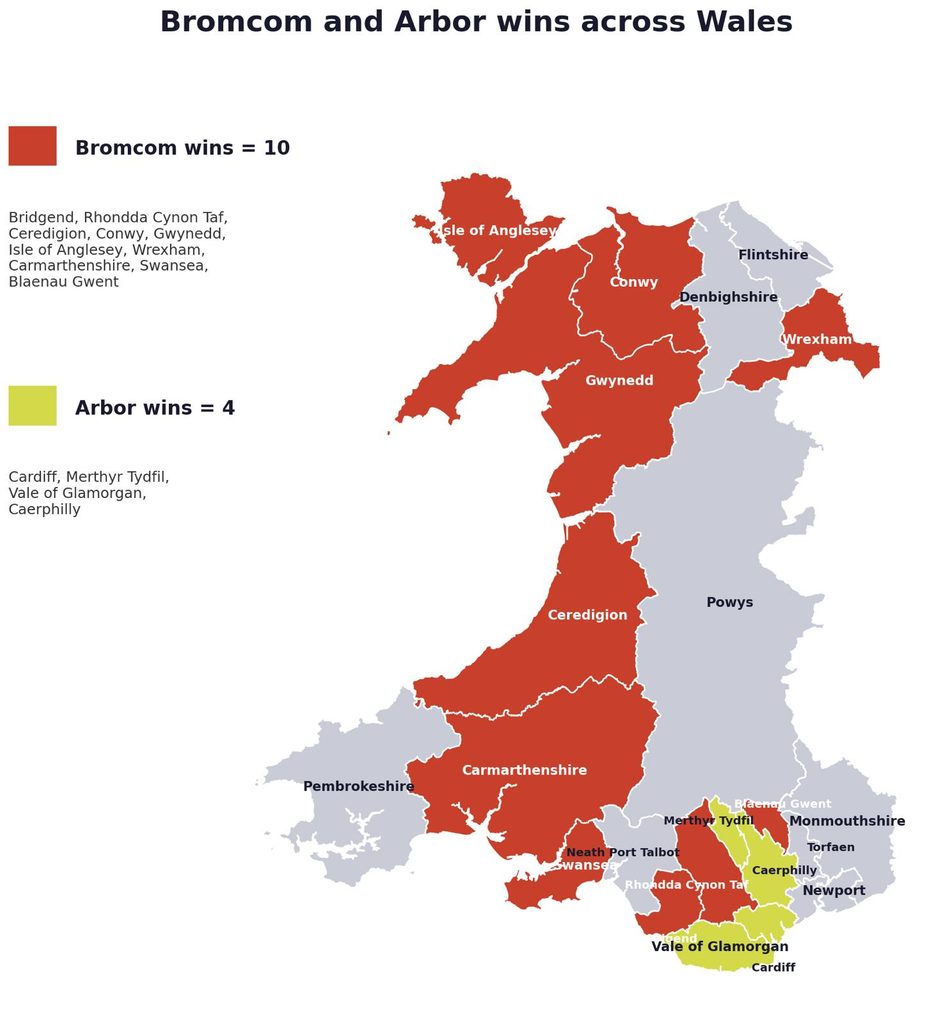
Bromcom’s latest success in Wales, with Blaenau Gwent becoming its tenth Welsh local authority, provides another indication of just how rapidly the UK’s school Management Information System landscape is changing.
But perhaps the more interesting story is not which supplier is winning which contract.
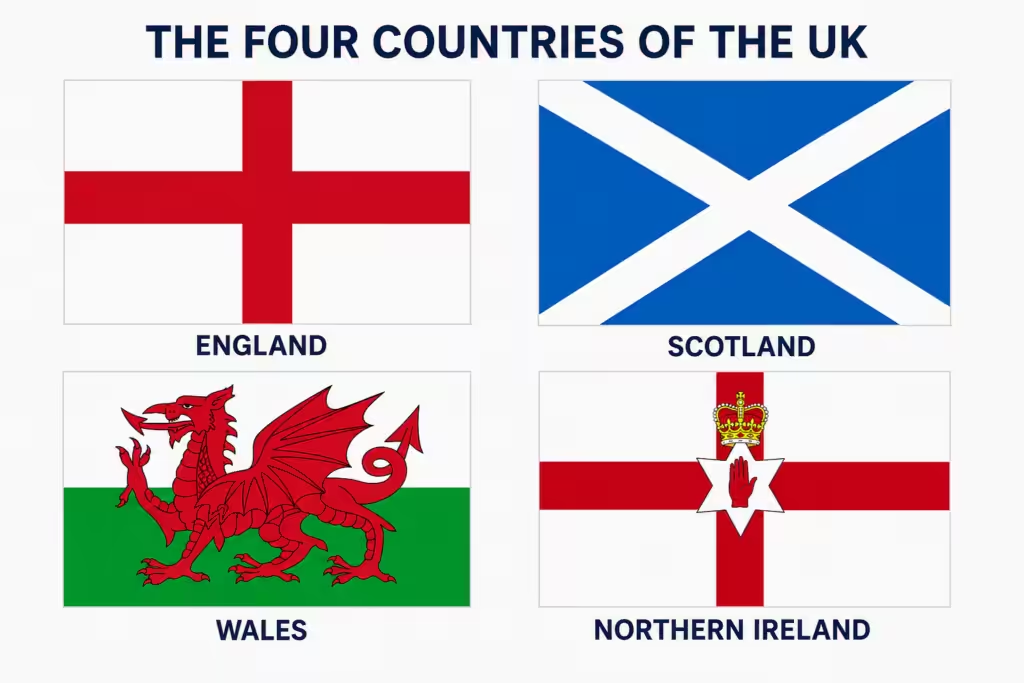
Look across the four nations of the UK and we are seeing four quite different approaches to the future of school MIS – and they raise an important question for England.
Is an MIS simply another piece of software to be bought through a procurement framework, or has it become part of the critical digital infrastructure on which our schools and education system depend?
The distinction matters.
Wales – local authorities testing the market
Wales provides perhaps the clearest example of genuine competition changing an established market.
For many years SIMS was overwhelmingly dominant across Welsh schools. That position is changing rapidly as local authorities review their arrangements and undertake procurements for modern cloud-based alternatives.
Bromcom’s latest Blaenau Gwent win takes its reported total to ten Welsh local authorities – a remarkable change from July 2024, when Wrexham became its first Welsh authority.
Other suppliers are also participating in the changing Welsh market, meaning authorities have an opportunity to consider different approaches rather than simply perpetuating the incumbent solution.
There is an important point here.
The Welsh model is not simply about obtaining the lowest price for an MIS licence. Local authorities can evaluate the wider solution: functionality, implementation, migration, support, finance, integrations, security, development roadmap and the ability of the supplier to meet the particular requirements of Welsh schools.
Changing MIS across an authority is a significant transformation programme. Treating it as such allows the procurement process to reflect that complexity.
Northern Ireland – one strategic decision
Northern Ireland has taken a very different approach.
Rather than individual schools or authorities selecting independently, the Education Authority undertook a major procurement through its Education Information Solutions (EdIS) programme.
The result was the selection of Bromcom as the new School Management System for Northern Ireland, replacing SIMS across approximately 1,100 schools.
The rollout is now underway and is expected to be completed by March 2027.
What is interesting about Northern Ireland is the scale at which the MIS has been considered.
It is not being treated simply as an isolated administrative application. The Education Authority describes the new system in terms of improving data flows between schools, parents and support services, reducing administrative workload, enabling collaborative and multi-school working and providing better information for planning and intervention.
That is much closer to viewing MIS as education infrastructure rather than simply software procurement.
There are, of course, risks associated with putting an entire country’s schools onto a single platform. Competition effectively occurs at the procurement stage rather than continuously at school level.
But there is also strategic coherence: one decision, common standards and an implementation programme designed around the education system as a whole.
Scotland – the national model reaches a crossroads
Scotland offers yet another model.
SEEMiS has long been the standard education MIS used across Scotland’s local authorities, creating a level of consistency that England has never had.

However, Scotland is now facing its own major decision about what comes next.
In February 2026, Scotland Excel published a Prior Information Notice for an Education Management Information System for Scotland, explicitly stating that it was seeking a solution to replace the SEEMiS system operating across all Scottish local authorities.
That is potentially one of the most significant MIS procurements in the UK.
Recent local authority discussions have also highlighted some of the challenges associated with the existing system, including its age and capabilities and the risks associated both with continuing with SEEMiS and moving to an alternative.
Scotland therefore has the opportunity to ask a fundamental question before selecting the technology:
What should a national education information architecture look like for the next decade?
The answer may be another national platform. It may involve a commercial provider. It may eventually involve a more open ecosystem.
But importantly, the debate starts from the requirements of the education system rather than simply from the mechanics of purchasing software.
And then there is England…
England is considerably more complicated.

Schools, local authorities and multi-academy trusts operate in a highly competitive MIS market, with Arbor, Bromcom, SIMS, Compass and other providers competing for business.
That competition has unquestionably driven innovation.
Cloud adoption has accelerated, functionality has improved and schools have far more choice than they did when one supplier controlled the overwhelming majority of the English market.
Latest WhichMIS? analysis of the May 2026 census data demonstrates just how dramatic that change has been. SIMS, which had more than 85% of English schools around a decade ago, has fallen to around 26%, while Arbor and Bromcom have grown rapidly and newer entrants such as Compass are gaining schools.
https://www.whichmis.com/mis-stats-from-the-may-2026-census-returns/
Competition has worked.
Which is why the Department for Education’s current work on its proposed Management Information Systems for Schools framework and Data Spine deserves careful scrutiny.
The DfE has already published its MIS Core Principles and is engaging with the market over both the proposed procurement framework and increased flows of information from school MIS platforms into the Department.
The ambition behind much of this is understandable.
Common standards, improved contractual terms, easier procurement, stronger interoperability and better access to timely education data could all deliver substantial benefits.
But there is also a danger.
An MIS is not a commodity
Framework procurement works particularly well where products or services can be readily compared against a common specification.
But should we really think about school MIS in the same way?
An MIS sits at the heart of almost every school’s operation.
It manages pupil records, attendance, safeguarding information, assessment, statutory returns, communications and increasingly payments, finance, HR, analytics and parental engagement.
It connects to dozens – sometimes hundreds – of other education applications.
For a MAT, it can also become the data foundation for trust-wide decision making.
And under the DfE’s emerging Data Spine ambitions, the MIS could increasingly become the gateway through which near-real-time information moves between schools and central government.
That doesn’t sound very much like a commodity.
It sounds like critical national education infrastructure.
Frameworks should enable choice – not define the product
There is therefore an important balance for the DfE to strike.
A national MIS framework could be extremely valuable if it makes procurement easier while protecting schools through sensible contractual principles, interoperability requirements, cybersecurity standards and transparent pricing.
But the framework should enable informed choice rather than inadvertently encourage buyers to see compliant MIS products as broadly interchangeable.
They aren’t.
Different schools and MATs have different requirements. Suppliers have different strengths, architectures, development roadmaps, integration strategies, support models and approaches to areas such as finance, analytics and AI.
Price matters.
But so do implementation capability, migration quality, reliability, usability, integrations, support and the supplier’s ability to keep developing its platform for many years after the procurement has finished.
Indeed, the cost of choosing the wrong MIS is likely to dwarf relatively small differences in licence price.
Four countries – and a useful lesson
The four UK nations therefore provide an interesting natural experiment.
Wales is seeing local authorities use procurement to challenge an established market and select solutions against their own strategic requirements.
Northern Ireland has made a country-wide strategic technology decision and is implementing a common platform across approximately 1,100 schools.
Scotland is considering how to replace a national MIS infrastructure that has served all its local authorities.
And England is attempting something different again – retaining a competitive supplier market while simultaneously creating stronger national procurement standards and developing a Data Spine.
There is much to welcome in England’s ambition.
But there is also a risk that, in trying to simplify MIS procurement, we oversimplify what an MIS actually is.
The objective should surely not be to make MIS products look more alike.
It should be to establish the standards that allow different, innovative MIS platforms to compete effectively, interoperate properly and give schools genuine choice.
That means defining the rules of the road – data standards, security, interoperability, contractual fairness and portability – without unnecessarily prescribing the vehicle.
As the DfE continues to grapple with its new framework and Data Spine proposals, that distinction will become increasingly important.
Because the modern school MIS is no longer simply the electronic register and census system it might once have been perceived to be.
It is becoming the digital backbone of the school.
And digital backbones should not be procured as commodities.