As we move towards the end of the 2025/26 financial year, many schools and MATs are either completing—or actively preparing for a migration to a new Management Information System (MIS).
To support this crucial phase, WhichMIS continues to promote our Key Considerations When Changing Your MIS https://www.whichmis.com/key-considerations-when-thinking-of-changing-your-mis/ guidance, which helps schools and trusts make well-informed, defensible and future-proof decisions.
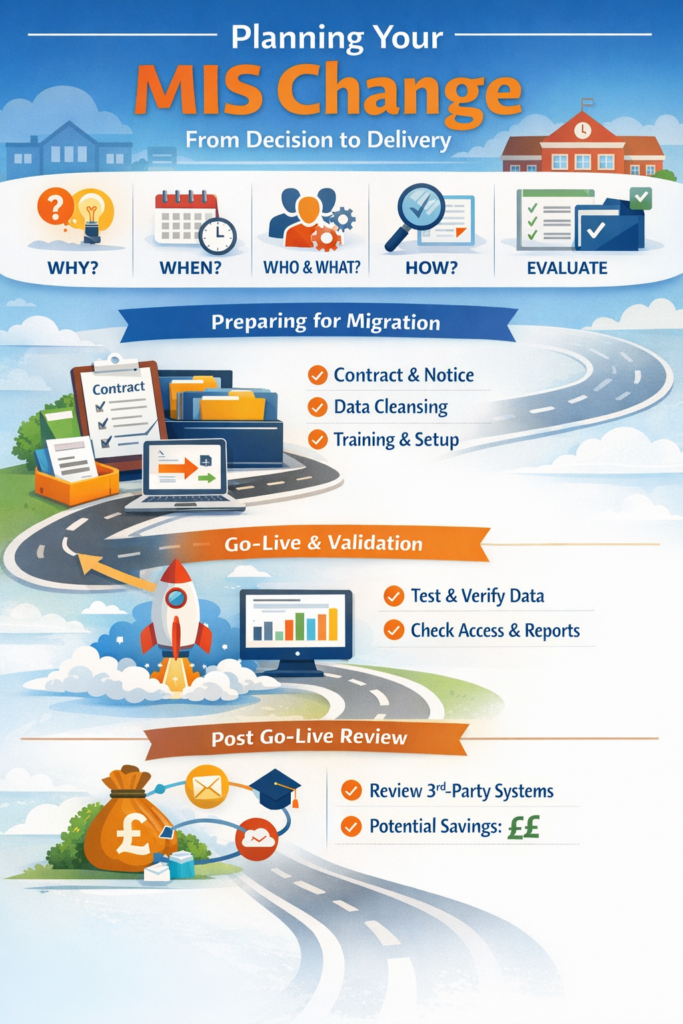
1. Why are you changing?
Every school and trust has its own reasons for reviewing its MIS. These may include dissatisfaction with functionality, poor support, rising costs, changes in organisational structure, or the need for better reporting and compliance.
Being clear about why you are changing is essential. It defines your priorities, shapes your specification, and provides a benchmark against which any new system must be judged.
2. When should you change?
There is no perfect time to migrate, but there is always a better time. Factors such as census periods, exam seasons, and the start of the academic year must be carefully avoided. The optimal window is one that balances operational stability with project momentum and supplier availability.
3. Who should be involved—and what do you need?
These two questions go hand in hand.
You must be clear about what you want your new MIS to deliver, both in terms of core functionality and any additional features.
To achieve this, you also need the right people involved at the right stages:
- A specification group to define what is required
- An evaluation group to assess supplier responses
These may not be the same individuals, but both should include a cross-section of stakeholders, including leadership, administration staff and end-users.
4. How will you procure?
Do not limit your options to the one or two systems you hear about most often. A robust procurement process requires you to demonstrate that you have explored the market, compared multiple suppliers, and applied consistent, fair and transparent criteria to all.
5. How will you evaluate?
The importance of a structured, defensible evaluation process has never been greater. Recent procurement challenges have made it clear that:
- Evaluators must be appropriately trained and supported
- Scores must be justified with clear written evidence
- Independent scoring should be followed by a transparent moderation process
This protects both your organisation and the integrity of the decision.
In summary
Changing your MIS is a major organisational undertaking. It requires clarity of purpose, strong governance, and disciplined project management.
From defining your needs and running a compliant tender, to evaluating bids and documenting decisions, every stage must be planned, executed and evidenced carefully.
Through supporting schools and MATs over the past 12 months, we have seen first-hand what works, and what can go wrong. Once you have selected your new MIS, the real work begins.
Once you’ve made the decision
Contract and notice
- Ensure your new contract is correct, particularly in relation to term, pricing and start date
- Give written notice to your current supplier and obtain confirmation of receipt
Prepare for migration
- Compile a full list of all third-party systems and integrators (for example, Wonde or Xporter)
- Identify your main MIS administrators (there should be at least two)
Agree your go-live date
Work backwards from your intended go-live to agree a realistic timetable with your new supplier. Avoid census periods and the start of term wherever possible.
Remember that your data will usually be “uplifted” a week or so before go-live.
Any changes made in the old MIS after that point will not appear in the new system, so data entry should be kept to an absolute minimum. Attendance can still be recorded and transferred or updated manually.
Cleanse your data
The old saying “rubbish in, rubbish out” applies more than ever. Invest time in checking and cleaning your data before migration to avoid carrying errors forward.
Training
Most suppliers require a minimum level of training before go-live. This may include online modules, live webinars and user guides.
Office staff will need significantly more training than classroom users, and it is vital to keep a record of who has completed which courses.
Validate the migrated system
When you receive access to your new MIS with migrated data:
- Check staff roles and access permissions
- Review a sample of pupil records, including personal details, contacts, SEND and medical data
- Verify staff contracts and personal details
- Run standard reports to confirm data integrity
- Import any missing attendance data and verify totals
- Ensure all staff can log in and access what they need
After go-live
Allow a short bedding-in period to resolve early issues—most commonly around reporting and workflows. Then schedule follow-up training in specialist areas such as assessment, reporting and timetabling.
Review your third-party systems
Once your new MIS is operational, review all third-party platforms and their renewal dates. Many schools find that modern MIS platforms replace significant amounts of external software at no additional cost.
Recent case studies show potential annual savings of:
- £1,000–£2,000 per primary, special and PRU school
- £5,000–£20,000 per secondary and all-through school
A well-planned MIS migration does not just modernise your systems—it can also deliver substantial financial and operational benefits.
If all this seems a bit scary, or you feel you could do with help, please feel free to contact us for a no obligation chat via whichmis@thewisdompartnership.com
Or look at our MIS procurement services https://www.whichmis.com/mis-procurement-services-for-schools-and-multi-academy-trusts-mats/