
In light of last week’s article on the DfE’s plans to introduce a new national framework for Management Information Systems (MIS), with the aim of making it easier for schools and trusts to procure, manage and switch MIS platforms, We thought it wise to remind you why Schools should use a Procurement Framework for MIS Purchasing.
The market for Management Information Systems (MIS) in UK schools has changed dramatically over the last five years. Cloud platforms, subscription pricing, interoperability demands, cyber security expectations and increasingly complex contract structures mean that buying an MIS is no longer a straightforward software purchase.
For schools and trusts, procurement frameworks are increasingly becoming the safest and most effective route to market.
The Department for Education (DfE) recommends several approved procurement frameworks for ICT purchasing, including MIS platforms. Among the most commonly used are:
Each offers a compliant procurement route, but there are important differences in how they operate, the level of support they provide, and the flexibility available to schools and MATs.
Why Procurement Frameworks Matter
A procurement framework is essentially a pre-approved route to buying goods and services compliantly under UK public procurement regulations.
Suppliers on frameworks have already been vetted for:
- Financial stability
- Insurance and compliance
- Quality standards
- Pricing structures
- Contractual terms
- Procurement legality
This means schools can purchase more quickly and with significantly reduced legal and procurement risk.
For MIS procurement specifically, frameworks can help schools:
- Avoid lengthy tender exercises
- Reduce procurement workload
- Ensure compliance with procurement law
- Achieve demonstrable value for money
- Maintain a defensible audit trail
- Reduce risk of supplier challenge
The Three Main DfE-Recommended Framework Routes

What is CCS?
Crown Commercial Service is the UK Government’s central procurement organisation and the largest public sector buying body in the UK.
It provides national procurement frameworks across almost every category of public spending, including ICT and cloud software services.
Strengths
- Extremely robust and legally established
- Large supplier ecosystem
- Strong governance and procurement credibility
- Particularly suitable for large MATs and complex procurements
- Extensive framework documentation and standardisation
Potential Limitations
- Can feel bureaucratic for smaller schools
- Less education-specific support
- Schools may still require significant external procurement expertise
- Processes can sometimes be slower and more formal
Best suited for:
- Large MATs
- Schools with dedicated procurement teams or external advisors
- Complex or high-value MIS procurements
- Trusts already familiar with government procurement procedures
What is Everything ICT?
Everything ICT is a DfE-approved ICT procurement framework specifically designed around education sector purchasing.
Unlike CCS, Everything ICT is highly education-focused and positions itself as a hands-on procurement partner for schools and MATs.
The framework supports:
- Direct awards
- Multi-quote exercises
- Mini-competitions
- Procurement guidance and support
Importantly, Everything ICT states that the contract sits with the framework provider rather than directly with the supplier — something some schools may see as an additional layer of protection, whilst others might prefer a direct contract with the provider.
Strengths
- Strong education sector focus
- Very accessible for schools with limited procurement experience
- Faster and more flexible procurement routes
- High-touch customer support
- Particularly popular among schools and MATs
Potential Limitations
- Less “central government” prestige than CCS
- May not suit highly bespoke enterprise procurement exercises
- Framework structure may feel less formal for some procurement teams
- Higher fees for suppliers, meaning not all MIS suppliers are on this framework
Best suited for:
- Standalone schools
- Small and medium MATs
- Schools wanting a small degree of procurement advise
- Schools moving MIS for the first time
- Faster procurement exercises
What is Procurement Services?
Procurement Services operates as a specialist procurement organisation supporting education and public sector buying.
Its approach tends to sit somewhere between the scale of CCS and the education-focused support model of Everything ICT.
Strengths
- More personalised support than large national frameworks
- Procurement expertise tailored to education
- Often flexible and consultative and can sometimes help schools navigate supplier evaluation.
Potential Limitations
- Smaller market presence than CCS
- Less brand recognition nationally
- Framework coverage may be narrower depending on category
Best suited for:
- Schools wanting specific assistance with procurement
- MATs needing guidance but not full CCS complexity
- Organisations wanting a balance between structure and flexibility
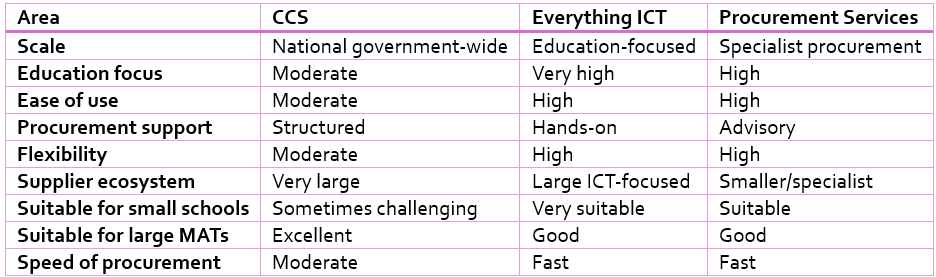
Key Differences at a Glance
The Risks of NOT Using a Framework
Some schools still attempt to procure MIS platforms independently, often through:
- Informal quote gathering
- Direct supplier negotiation
- Legacy supplier rollover
- Self-managed tenders
This can create significant risks.
1. Procurement Compliance Risk
Public sector procurement rules are increasingly scrutinised.
Without a compliant framework or properly run tender process, schools risk:
- Supplier challenge
- Audit criticism
- Governance concerns
- Potential procurement breaches
Frameworks reduce this risk because suppliers and terms have already undergone compliant procurement processes.
2. Poor Contract Terms
MIS contracts can be complex.
Without procurement expertise, schools may overlook:
- Auto-renewal clauses
- Exit fees
- Data migration costs
- Hosting limitations
- Support restrictions
- Price escalation terms
Frameworks often provide pre-negotiated contractual protections.
3. Weak Value-for-Money Evidence
Governors, auditors and trust boards increasingly expect evidence that schools have:
- Considered multiple suppliers
- Benchmarked pricing
- Followed a compliant route
- Achieved value for money
A framework provides a clear audit trail.
4. Reduced Market Visibility
The MIS market is changing rapidly.
Schools procuring alone may only evaluate incumbent suppliers or the “big three”, potentially missing:
- New entrants
- Specialist platforms
- Better pricing models
- More innovative solutions
Framework providers often help schools access a broader supplier market.
5. Increased Internal Workload
Running a compliant MIS tender independently can involve:
- Specification writing
- Procurement notices
- Supplier evaluation
- Clarification management
- Legal checks
- Scoring moderation
- Audit documentation
Frameworks can dramatically reduce administrative burden.
Final Thoughts
The move to cloud MIS platforms has made procurement more strategic than ever before.
Choosing the right framework is not simply about compliance — it is about:
- Reducing risk
- Saving leadership time
- Improving supplier comparison
- Strengthening governance
- Securing better long-term value
For many schools, the question is no longer whether to use a framework, but which framework best fits their level of procurement expertise, internal capacity and appetite for support.
For smaller schools and MATs wanting a guided, education-specific route, Everything ICT is increasingly popular.
For larger, procurement-mature trusts, CCS remains a highly credible and robust option.
And for organisations wanting a more consultative middle ground, Procurement Services can offer valuable specialist support.
In a market where MIS contracts are becoming more commercially and technically complex, using a recognised framework is rapidly becoming best practice rather than simply a procurement preference.
Whether you decide to use a framework, run a full tender or simply go with whoever a neighbouring school recommends, it is important to get expert advice.
WhichMIS can help – from free, independent advice through to managing the entire procurement process for you.
Changing your MIS is both a complex procurement process and also a full change management project and expert advice from the very beginning can ensure that your procurement goes smoothly and compliantly without the burden of additional work for your staff. Why not arrange a free advice session to understand your procurement options, the things you need to consider and the best way to manage the change.
is an independent service that supports schools, trusts, and local authorities in making informed decisions when selecting a Management Information System (MIS).
Drawing on extensive experience and sector insight, WhichMIS? offers impartial advice, practical resources, and up-to-date market intelligence to help education providers find the right system to meet their needs—whether they’re reviewing their current solution or going out to tender.
Our aim is simple: to empower schools to make confident, well-informed MIS choices that support their strategic and operational goals.
If you’re thinking about changing your MIS
Read our guide at WhichMIS