

A Quiet Revolution in School Data Management?
Following our article last month (below), we now publish an update on the DfE’s plans:
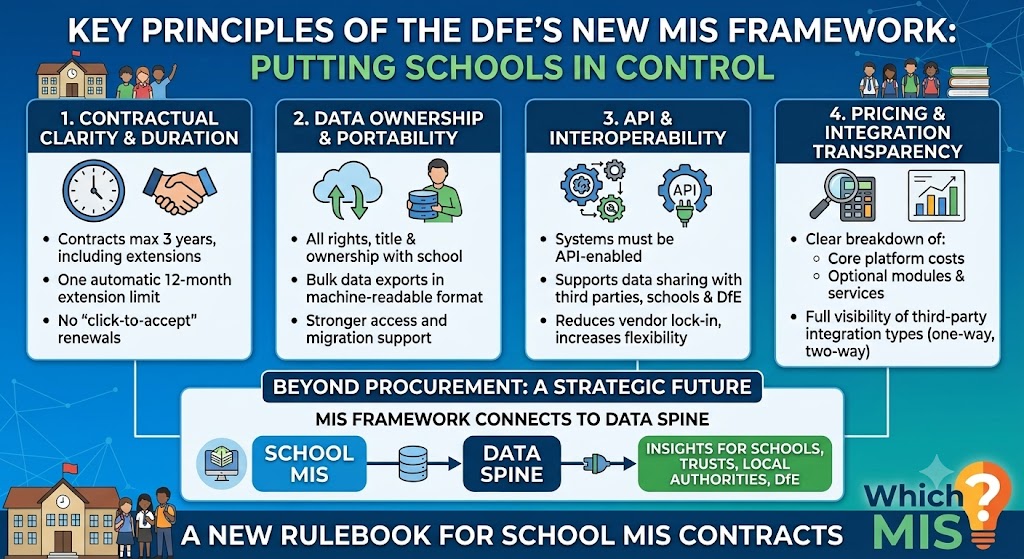
The Department for Education’s long-awaited Management Information Systems (MIS) framework is moving closer to reality, and while much of the sector’s attention has focused on which suppliers may be awarded a place, an accompanying document may prove to be far more significant.
Buried within the procurement documentation is a set of proposed “School MIS Supply – Core Principles” that schools are encouraged to adopt when procuring an MIS solution. If implemented as drafted, these principles could fundamentally change how schools contract with MIS suppliers and how school data is managed across the sector.
For years, schools have complained about complex contract terms, lengthy notice periods, data portability challenges and uncertainty over ownership and access rights. The DfE’s draft principles appear to address many of these concerns directly.
Putting Schools Back in Control
One of the most striking proposals is a clear limit on contract duration.
The draft states that MIS contracts should not exceed three years, including extension options, and that automatic renewals should be limited to a single 12-month extension before the contract automatically terminates.
If adopted widely, this would represent a significant departure from some historic arrangements where schools have found themselves rolling into successive renewal periods with limited visibility of alternatives.
The principles also seek to clarify who is authorised to enter into or vary contracts, explicitly limiting this to designated representatives such as CEOs, CFOs, Headteachers, School Business Managers or other delegated officers.
Perhaps even more significantly, the DfE proposes that “click-to-accept” contract renewals through supplier portals should not constitute a valid contractual agreement. This is likely to be welcomed by schools that have occasionally found themselves committed to contractual changes through routine administrative actions.
Data Ownership Finally Clarified?
For many schools and trusts, data portability has become one of the biggest considerations when selecting an MIS platform.
The draft principles are unusually clear on this point.
They state that all rights, title and ownership of school data remain with the school and that suppliers may only use that data for the delivery of services unless specifically authorised otherwise in writing.
Schools would also gain stronger rights to access their data throughout the contract term and during any exit process. Suppliers would be required to provide bulk exports in machine-readable formats and support migration activities when schools move between systems.
For a sector that has experienced significant MIS switching activity over the last three years, these provisions could reduce some of the friction traditionally associated with migrations.
The API Requirement
Another notable inclusion is the requirement that systems should be API-enabled and capable of supporting data sharing with third parties, other schools and the Department for Education.
On the surface, this aligns with the broader direction of travel towards greater interoperability and reduced vendor lock-in.
However, some suppliers may view this as one of the most challenging requirements within the document. While modern cloud-native platforms already provide extensive API access, not all systems have historically been designed around open data exchange.
The practical interpretation of this requirement could become one of the most closely scrutinised aspects of the framework.
Transparency Around Pricing and Integrations
The DfE is also seeking greater transparency from suppliers.
Bidders would be expected to provide clear breakdowns showing:
- Core platform costs
- Optional modules
- Bolt-on services
- Third-party integrations
- Whether integrations are one-way, two-way or routed through aggregators
For schools, this could provide a much clearer picture of the true cost of ownership before contracts are signed.
It may also expose significant differences between suppliers whose published prices appear similar but whose integration and add-on costs vary considerably.
Is This Really About Procurement?
While the proposed framework is presented as a procurement vehicle, the accompanying market engagement documentation points to a broader strategic objective.
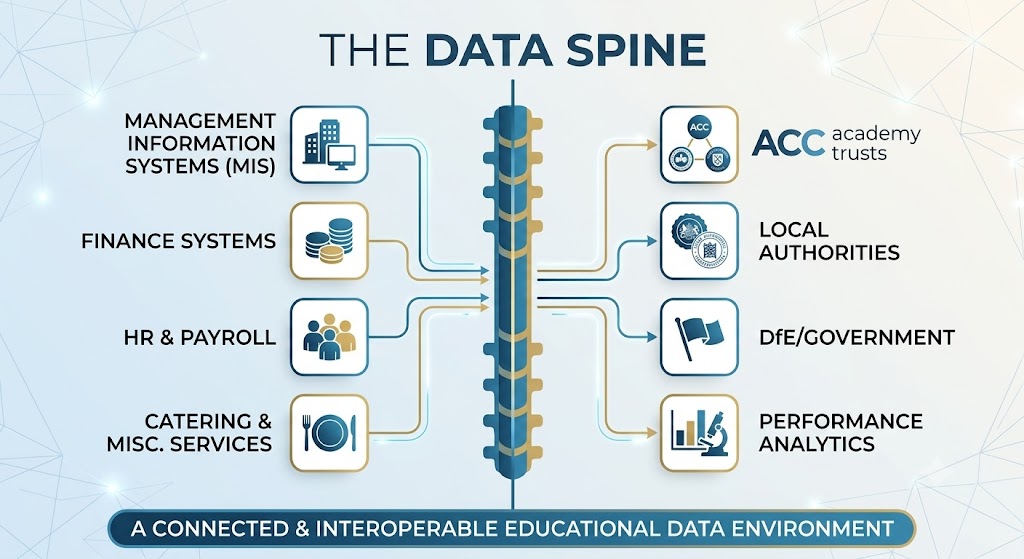
Alongside the development of a new route to market for school MIS systems, the Department for Education is actively engaging suppliers on the proposed Data Spine initiative, which aims to explore how school data can be used more effectively to provide new insights for schools, trusts, local authorities and the Department itself.
The DfE has stated that it anticipates outcomes from the Data Spine programme being included within the scope of the future MIS framework, creating a direct connection between procurement, interoperability and wider data-sharing ambitions.
The emphasis throughout the draft principles on API accessibility, standardised data structures, migration support and interoperability appears closely aligned with the technical foundations required to support such an ecosystem.
While the Department has been careful to stress that this remains a preliminary market engagement exercise rather than a formal procurement commitment, the direction of travel is becoming increasingly clear: future MIS platforms are likely to be expected not only to manage school data, but also to participate within a more connected and interoperable educational data environment.
The DfE Data Spine: From Concept to Market Engagement
One of the most significant developments within the latest market engagement exercise is the emergence of the DfE’s proposed Data Spine. Rather than focusing solely on MIS procurement, the Department is consulting suppliers on how data could be shared and utilised more effectively across the education system.
According to the engagement documentation, the initiative seeks to harness the potential of school data to generate new insights that can benefit schools, academy trusts, local authorities, parents and policymakers. Importantly, the DfE has indicated that outcomes from the Data Spine initiative are expected to be incorporated into the future MIS framework, suggesting that interoperability requirements are being driven by a much larger strategic programme.
Although the Department remains at the consultation stage and has not committed to a final architecture or procurement approach, suppliers responding before the September 2026 deadline have been given an opportunity to influence both the framework design and the future shape of the Data Spine itself.
What Happens Next?
The MIS framework procurement has already attracted significant market interest, with suppliers participating in DfE engagement activities throughout the past year. The Department has indicated that the framework is intended to provide schools with a compliant route to procure MIS systems while promoting greater consistency across the market.
For schools, the immediate takeaway is simple: pay attention not only to which suppliers appear on the framework, but also to the contractual principles sitting behind it.
Those principles may ultimately have a greater impact on schools than the framework itself.
WhichMIS? View

At WhichMIS?, we’ve long argued that schools should focus as much on contract terms, data ownership and exit arrangements as they do on functionality and price.
Many of the DfE’s proposed principles address issues that schools, trusts and procurement professionals have raised for years.
The unanswered question is whether these principles will remain guidance, become mandatory requirements within the new framework, or eventually establish a new contractual standard across the wider MIS market.
Either way, suppliers, trusts and school leaders should be paying close attention.
Because this may not simply be a new procurement framework.
It may be the beginning of a new rulebook for school MIS contracts.