
Following the publication of the Academy Trust Handbook 2026 and our recent article questioning how schools could be expected to use a mandatory MIS framework that does not yet exist, the Department for Education held another supplier briefing today to outline its proposals.
The session, led by Dan Baker from the DfE Procurement Team and hosted by BESA, attracted over 50 representatives from across the education technology sector and provided the clearest indication yet of how the Department intends the framework to operate.
Whilst today’s discussion answered a number of important questions, it also highlighted just how much work still lies ahead before the framework becomes a reality.
What We Learnt
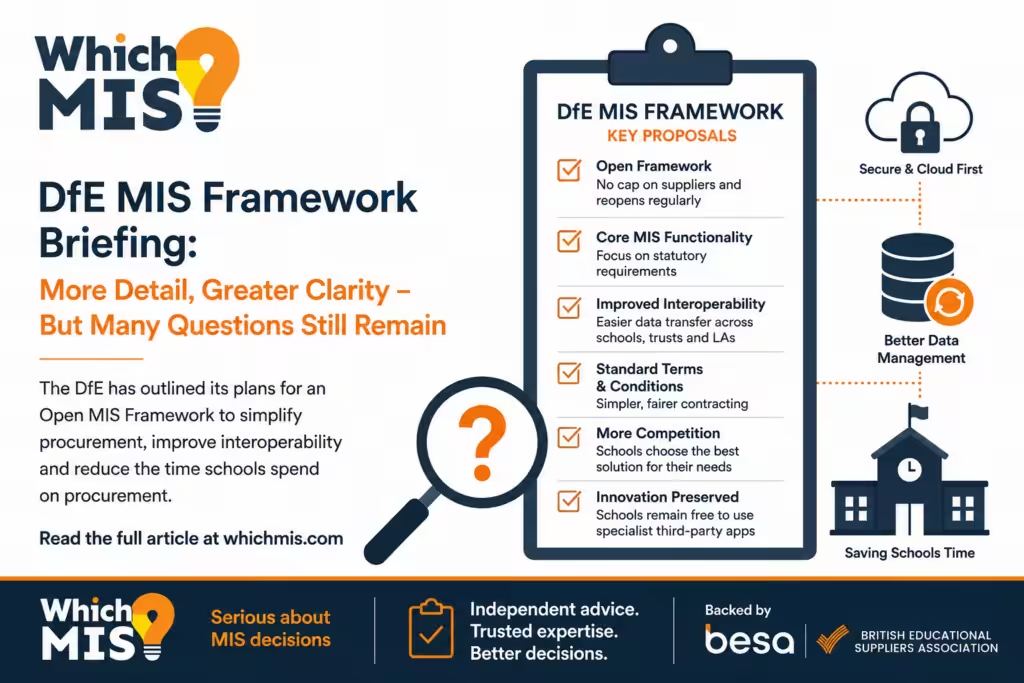
Perhaps the biggest takeaway is that the DfE is proposing an Open Framework under the Procurement Act 2023, rather than a traditional closed framework.
This would allow suppliers to join at regular intervals, potentially on an annual basis, rather than being locked out for several years. The framework would have no cap on supplier numbers and is intended to encourage competition whilst providing schools with a simpler route to procurement.
The DfE also confirmed that the framework will focus on core MIS functionality required to meet statutory obligations, including pupil records, attendance, census returns and reporting.
Importantly, officials repeatedly stressed that the framework is not intended to restrict schools from purchasing specialist third-party applications, such as safeguarding, finance, HR or other integrated solutions.
That reassurance will be welcomed by many suppliers whose products complement rather than replace the core MIS.
Procurement Rather Than Product
One message came across consistently throughout the session.
The DfE sees this primarily as a procurement project, not a technology project.
Officials believe many schools struggle with procurement regulations, contract management and supplier comparisons. By providing standard terms and conditions, common specifications and clearer procurement guidance, they hope to reduce procurement effort, improve interoperability and ultimately save schools time.
Whether those savings ultimately outweigh the additional implementation costs for suppliers remains an open question.
Interoperability Remains Central
The briefing also reinforced how closely the framework is linked to improving data interoperability.
The DfE wants to simplify pupil data migration, improve transfers when schools join academy trusts and establish more consistent approaches to data exchange across the sector.
Although the recently completed Data Spine Proof of Concept was discussed, officials confirmed that the MIS Framework will continue independently of that work.
Competition and Innovation
One of the strongest themes throughout the webinar came from suppliers questioning whether a mandatory framework could unintentionally reduce innovation.
Several attendees expressed concerns that increasing standardisation, mandatory requirements and greater emphasis on pricing could discourage investment and ultimately create a “race to the bottom”.
The DfE rejected that suggestion, stating that the framework is intended to encourage competition rather than reduce it. Officials stressed that schools will continue to define their own award criteria, apply their own weightings and choose the solution that best meets their requirements rather than simply selecting the cheapest option.
Only time will tell whether the market shares that confidence.
What About Other Frameworks?
Perhaps one of the more significant comments during the session related to existing procurement frameworks.
The DfE indicated that its new MIS Framework is expected to become the primary route to market for academy trusts and that this could ultimately replace other procurement frameworks currently offering MIS services.
That raises important questions for existing framework providers and for schools already familiar with those procurement routes.
Still Plenty of Unknowns
Despite today’s additional detail, many significant elements remain undecided.
Among the outstanding issues are:
- The precise definition of “core” MIS functionality.
- Payment mechanisms and pricing models.
- Standard terms and conditions.
- Data migration and contract exit processes.
- Framework performance measures and KPIs.
- How supplier costs of compliance will be balanced against the intended benefits.
- The DfE confirmed that further deep-dive workshops covering each of these areas will take place over the coming weeks, including:
- Product module “maps” and 3rd party integrations list
- Direct Awards/ Further Comp
- Payment Mechanism
- Terms & Conditions
- Data Principles
The WhichMIS? View
Today’s briefing represents an important step forward.
The DfE has clearly listened to many of the concerns raised since publication of the Academy Trust Handbook and has gone some way towards reassuring suppliers that innovation, third-party applications and market competition remain central to its thinking.
However, the framework remains very much a work in progress.
Many of the most important commercial and technical decisions have yet to be made, and the detail will determine whether the framework genuinely simplifies procurement without reducing choice or creating unintended barriers for suppliers.
One thing is certain: this is likely to become the most significant change to the school MIS marketplace in over a decade.
At WhichMIS?, we’ll continue to follow every stage of the framework’s development and provide independent analysis as further details emerge.
Changing your MIS is both a complex procurement process and also a full change management project and expert advice from the very beginning can ensure that your procurement goes smoothly and compliantly without the burden of additional work for your staff. Why not arrange a free advice session to understand your procurement options, the things you need to consider and the best way to manage the change.

is an independent service that supports schools, trusts, and local authorities in making informed decisions when selecting a Management Information System (MIS).
Drawing on extensive experience and sector insight, WhichMIS? offers impartial advice, practical resources, and up-to-date market intelligence to help education providers find the right system to meet their needs—whether they’re reviewing their current solution or going out to tender.
Our aim is simple: to empower schools to make confident, well-informed MIS choices that support their strategic and operational goals.
If you’re thinking about changing your MIS
Read our guide at WhichMIS