
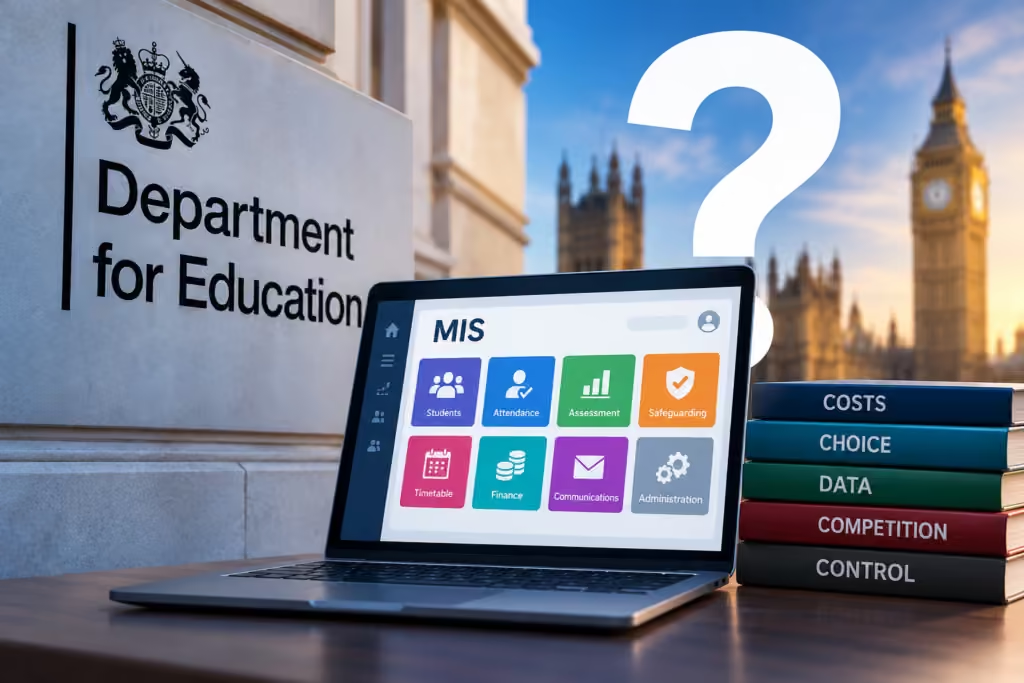
As new revelations emerge about the government’s ambitions for school management information systems, WhichMIS? examines the implications for competition, data protection and the future of the MIS market.
The Department for Education’s plans to reshape how schools purchase and use Management Information Systems (MIS) have taken an interesting turn.

An investigation published by Schools Week on 29 October 2026 reveals that DfE officials considered developing a government-owned MIS as a possible way of reducing costs for schools.
DfE pondered launching in-house MIS to save schools cash
Although there is no indication that the DfE has decided to proceed with such a system, the fact that the option was considered raises some important questions about the government’s ambitions for the school MIS market.
It also adds a new dimension to the ongoing debate surrounding the proposed national MIS procurement framework and the associated data spine initiative.
A Government-Owned MIS – An Attractive Proposition?
At first glance, the idea of a publicly funded MIS might appear attractive.
Schools collectively spend substantial sums each year on management information systems, with the English school MIS market estimated to be worth approximately £200 million annually.
For a government seeking to reduce expenditure and improve efficiency, the prospect of providing schools with a standardised system at a lower cost could be appealing.
However, developing an MIS is one thing. Maintaining, supporting and continually improving it is quite another.
Modern MIS platforms are complex systems that underpin almost every aspect of school administration, including attendance, assessment, safeguarding, admissions, reporting, finance and communication.
They also require continuous investment to respond to changing statutory requirements, evolving technology and the differing needs of primary, secondary, special and independent schools.
A government-owned system would therefore need to compete not only on price but also on functionality, reliability, support and innovation.
And there is a fundamental question: would government ownership actually reduce the total cost of providing an MIS, or simply transfer those costs from school budgets to the taxpayer?
The MIS Market Has Already Changed Dramatically
The government’s interest comes at a time when the English MIS market has undergone considerable transformation.
For many years, SIMS dominated the sector, and although SIMS7 has been available on-line and Next Gen is fully cloud based, the emergence and growth of other cloud-based alternatives, including Arbor and Bromcom, has fundamentally changed the competitive landscape.
Other providers are also developing their propositions, giving schools a wider range of options than was available historically.
Competition has helped drive investment in cloud technology, improved accessibility, integration and new functionality.
Nevertheless, the market has not been without difficulties.
Contractual disputes, procurement challenges, supplier switching costs and concerns over access to school data have all featured prominently in recent years.
It is understandable, therefore, that the DfE wants to address some of these issues.
But there is an important distinction between regulating and improving a market and becoming a participant in that market.
The former could strengthen competition and protect schools. The latter would introduce an entirely different set of challenges.
The Data Spine – A More Significant Development?
While the prospect of a government-owned MIS makes an eye-catching headline, the proposed national data spine may ultimately have far greater implications.
The DfE has presented the initiative as a way of improving interoperability and enabling information to move more effectively between schools, academy trusts, local authorities and government.
There are potential benefits.
Schools currently face considerable challenges when transferring information between systems, particularly during MIS migrations, academy conversions and trust reorganisations.
Improved interoperability, common data standards and more efficient information sharing could reduce administrative workloads and make it easier for schools to change suppliers.
These are objectives that many in the sector would welcome.
However, questions remain about the extent of the information that could be accessed, how it would be used and who would control it.
Recent reporting has highlighted concerns raised by Sir Jon Coles, chief executive of United Learning, about the proposed data spine and the level of consultation undertaken with schools and trusts.
The concerns are significant because school MIS platforms contain some of the most sensitive information held within the education system.
Any national data infrastructure must therefore be accompanied by clear safeguards, transparent governance and a well-defined purpose.
Schools need to understand precisely what information would be shared, under what legal authority, with whom and for what purpose.
Improving interoperability should not automatically mean unrestricted central access to school data.
The DfE MIS Framework – A Positive Step, But Questions Remain
As WhichMIS? has reported in previous articles, the DfE is developing a national MIS procurement framework, currently expected to launch in September 2027.
The framework aims to simplify purchasing, improve contractual terms, strengthen security requirements and make pricing more transparent.
These are worthwhile objectives.
Schools have often struggled to compare MIS suppliers on a consistent basis, and procurement can be particularly challenging for smaller schools without specialist expertise.
A well-designed framework could make the process easier while providing stronger protection against unreasonable contractual restrictions.
However, the proposed requirement for academy trusts to use the framework introduces further questions.
Will schools retain genuine freedom to select the MIS that best meets their needs?
Will the framework accommodate smaller and emerging suppliers, or could it inadvertently reinforce the position of established providers?
How will innovation be encouraged?
And, importantly, will schools be able to demonstrate value for money through alternative compliant procurement routes where appropriate?
There is also the issue of how the framework and data spine will interact.
If access to the national data infrastructure becomes dependent on particular technical standards or procurement arrangements, suppliers and schools will need clarity well before implementation.
Should the Government Be Referee or Player?
The revelation that officials considered developing an in-house MIS brings us back to a broader question about the appropriate role of government.
There is a strong argument for the DfE establishing common standards for data exchange, cybersecurity, procurement and contractual fairness.
These measures could help create a healthier and more competitive market.
However, becoming an MIS supplier itself would raise potential conflicts between the government’s responsibilities as regulator, purchaser, standard-setter and commercial competitor.
Would a government-owned MIS be subject to the same commercial and technical requirements as private-sector suppliers?
How would investment decisions be made?
Would schools have a genuine choice of systems?
And could a publicly funded platform discourage private-sector investment in future innovation?
These are not arguments against exploring different approaches. Indeed, government should be prepared to challenge established market structures where there is a clear benefit to schools.
But any proposal to enter the market directly would need a convincing business case, transparent costings and a clear demonstration that it would deliver better outcomes than a competitive supplier market.
What Should Schools and MATs Do Now?
For schools and trusts currently reviewing their MIS arrangements, these developments should not be a reason to put decisions on hold indefinitely.
The DfE’s framework remains under development, and schools must continue to manage their existing contractual and operational requirements.
However, there are several areas worth monitoring:
- Contractual flexibility:
- Understand renewal dates, notice periods, exit provisions and data transfer arrangements.
- Interoperability:
- Ask suppliers how they intend to support emerging DfE standards and the proposed data spine.
- Data governance:
- Seek clarity on data ownership, access permissions, security and future information-sharing requirements.
- Supplier choice:
- Consider functionality, support, implementation capability and long-term value rather than headline price alone.
- Future procurement:
- Keep abreast of the framework timetable and the implications for existing and future contracts.
Schools should also take advantage of opportunities to contribute to the DfE’s consultation and market engagement activities.
After all, the people who depend on these systems every day should have a meaningful voice in shaping their future.
The WhichMIS? View
The DfE’s ambition to reduce costs, improve procurement and make school data more accessible is understandable.
There are genuine problems within the existing MIS market, and government intervention to establish fairer contractual terms, consistent standards and better interoperability could deliver substantial benefits.
But the latest revelations demonstrate just how far-reaching the government’s thinking may have become.
In our view, the priority should be to create the conditions in which schools can make informed decisions, suppliers compete fairly and data moves securely between systems. That does not necessarily require the government to develop its own MIS.
Scotland adopted a similar approach some years ago with the development of SEEMiS, a management information system wholly owned by its 32 local authorities. However, over time, the platform has struggled to keep pace with technological developments and the evolving needs of schools. As a result, a growing number of Scottish local authorities are now exploring alternative commercial MIS solutions available across the UK.

This experience offers a useful reminder that developing a publicly owned MIS is only the beginning; maintaining its relevance, functionality and competitiveness requires sustained investment and innovation.
Indeed, the greatest opportunity may lie in establishing an open, transparent and genuinely competitive environment that encourages innovation while protecting schools from unnecessary costs and contractual restrictions.
The national data spine deserves particular scrutiny. Its potential benefits are considerable, but so too are the responsibilities associated with handling sensitive information relating to millions of pupils.
As the DfE continues to develop its proposals, greater transparency and meaningful engagement with schools, trusts and suppliers will be essential.
Ultimately, the success of these initiatives should not be judged simply by how much money the government hopes to save.
It should be judged by whether schools end up with better systems, greater choice, stronger data protection and improved value for money.
Source acknowledgement: This article was prompted by reporting from Jack Dyson in Schools Week, published on 29 October 2026, under the headline “DfE pondered launching in-house MIS to save schools cash”. WhichMIS? has provided its own independent analysis and commentary on the implications for the school MIS market.