

More than 650 primary schools and primary EOTAS settings are now using Northern Ireland’s new school management system. Meanwhile, the Welsh procurement picture illustrates how different authorities are approaching their next MIS decision.
Northern Ireland’s Education Authority (EA) has reported that more than 650 primary schools, including primary Education Otherwise Than at School (EOTAS) settings, are now live on Bromcom.
In its update published on 4 November, the EA said the primary rollout remained on schedule to finish by the end of November 2026. Onboarding was also continuing for post-primary schools, special schools and post-primary EOTAS settings, with the announcement giving March 2027 as the planned completion date across all sectors.
The milestone provides a useful opportunity to look beyond supplier selection and consider the practical task of moving schools to a new system.
Northern Ireland: attention turns to implementation
The rollout forms part of the EA’s Education Information Solutions (EdIS) programme.
The latest update includes positive feedback from two primary schools about preparation and training. Nettlefield Primary School highlighted the staged transition process, while St Comgall’s Primary School pointed to the value of online resources that staff could revisit. These accounts offer an early view of participating schools’ experiences, rather than a comprehensive assessment of the programme’s outcomes.
For WhichMIS?, the next questions concern what happens after schools go live: how confidently staff use the system, how quickly issues are resolved, and whether the transition produces measurable improvements in everyday administration.
Wales: a different procurement picture
Alongside developments in Northern Ireland, the accompanying Wales map brings together reported supplier selections and procurement stages across Welsh local authorities.
The supplied snapshot identifies Bromcom selections across nine authorities, Arbor across four, and ESS SIMS across two. It also shows authorities at evaluation, review or other stages.
That distinction matters. A supplier selection, a signed contract and a completed school migration represent different milestones. The map should therefore be read as a procurement snapshot, rather than a count of schools actively using each platform.
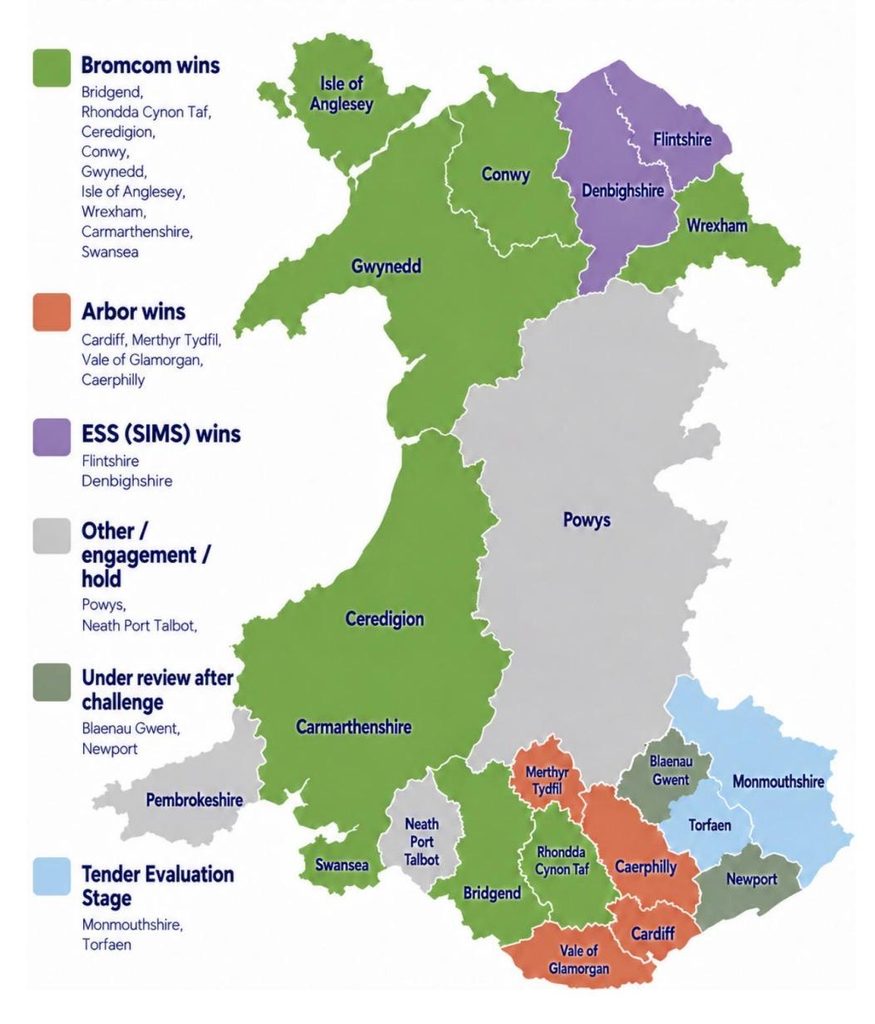
Content correct at 6th November 2026
Newport illustrates why the date and status behind each entry are important. A published Sell2Wales award notice names Bromcom as the supplier, while recording the contract as pending and giving an estimated signing date of 13 November 2026. That notice establishes a published award position, but does not by itself confirm that a contract has been signed or that schools have migrated.
What should schools take from these developments?
Our reading is that these updates highlight two distinct tasks: choosing an appropriate system and delivering a successful transition.
For schools and authorities reviewing their MIS, the practical questions include:
- Readiness: Have data, reporting requirements and existing processes been reviewed before migration?
- Training: Can staff practise the tasks they will need from their first day on the new system?
- Connections: Have essential third-party services been checked, including any additional costs?
- Support: Is responsibility clear when an issue involves the school, authority, MIS supplier or another provider?
- Outcomes: How will leaders assess workload, data quality, service reliability and overall value after implementation?
These questions apply whichever supplier is selected.
Northern Ireland’s latest figures provide a significant progress marker. The developing Welsh picture adds a different perspective, with several suppliers and procurement stages represented. For both, the longer-term story will be how effectively the arrangements support schools once procurement and migration give way to everyday use.
The WhichMIS? View
The developments in Northern Ireland and Wales bring a wider policy question into focus: should public bodies develop their own MIS, or procure established platforms and hold suppliers accountable for their delivery?
In our recent article examining the DfE’s consideration of a government-owned MIS, we highlighted the challenge of sustaining a publicly developed system. Scotland’s experience with SEEMiS offers a cautionary example: ownership alone does not guarantee that a platform will keep pace with schools’ changing needs.
Our assessment is that building a new national MIS capable of matching established commercial offerings would likely take years and considerable investment. During that development period, existing suppliers would continue improving their products, leaving the new system chasing a moving target.
The commitment would also extend far beyond the initial build. Statutory updates, security, integrations, training, support and continuing development all require sustained funding and specialist expertise.
Northern Ireland demonstrates an alternative approach: centrally coordinated procurement and implementation using a commercial platform. Wales illustrates a more varied picture, with different authorities selecting different suppliers. Both approaches still require rigorous scrutiny of cost, service quality and outcomes.
For WhichMIS?, the strongest role for government is to set clear standards, protect schools’ interests and support fair competition. Commercial suppliers must then demonstrate that they can deliver reliable systems, effective support and long-term value.
The real measure of success is whether schools receive better systems and services at a sustainable cost.