

The Schools & Academies Show at ExCeL London highlighted just how central technology has become to the operational and strategic priorities of schools and trusts.
Major MIS providers, EdTech suppliers, consultants and support services were all well represented, while busy speaker theatres drew strong audiences for discussions on the sector’s most pressing challenges.
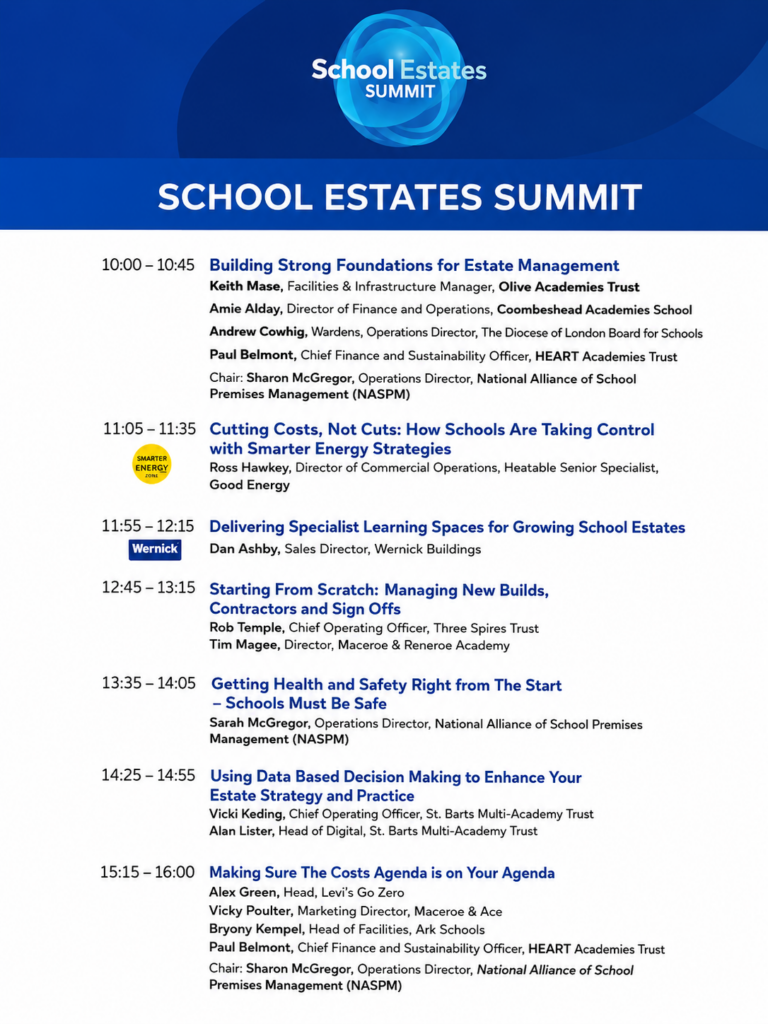
One of the most noticeable developments this year was the growing prominence of schools estate management. The dedicated theatre focusing on estates, compliance and sustainability attracted significant interest, highlighting how school leaders are increasingly required to balance operational resilience, financial efficiency and long-term strategic planning across all areas of school management — not just teaching and learning.
For the team at WhichMIS?, one of the most interesting themes emerging from conversations across the day was the continuing appetite for MIS change.
Schools Continue to Reassess Their MIS Choices
We spoke with a large number of senior leaders, business managers and trust executives actively reviewing their current MIS arrangements.
While many schools continue to explore migration away from SIMS, there was also increasing evidence that the market is maturing beyond simple “move away from legacy” conversations. Several schools currently using Bromcom and Arbor were also assessing alternative options and considering whether their current platforms continue to meet their evolving operational requirements.
These conversations reflected a broader trend we have observed over the last 12 months: schools are becoming more sophisticated and strategic in the way they evaluate MIS platforms.
Rather than focusing purely on functionality or price, many leaders are now asking wider questions including:
- How dependent are we becoming on a single supplier?
- How resilient is our data infrastructure?
- What happens if support quality changes?
- How open is the platform to integration and interoperability?
- Does the MIS align with our wider trust strategy?
Increasingly, schools are recognising that an MIS is not simply an administrative system. It is critical operational infrastructure.
Growing Awareness Around Supplier Reliance
Another recurring theme throughout the show was concern around supplier reliance and market concentration.
As platforms expand their ecosystems to include payments, communications, safeguarding, analytics, HR, parental engagement and finance, many school leaders are becoming more aware of the risks associated with placing too many operational functions within a single supplier environment.
This is not necessarily creating dissatisfaction, but it is prompting schools and trusts to think more carefully about procurement strategy, exit planning, data portability and interoperability.
The conversations at the show suggested that many trusts are now actively trying to balance the efficiencies of integrated platforms with the need to maintain flexibility and strategic control.
The DfE Data Spine Initiative
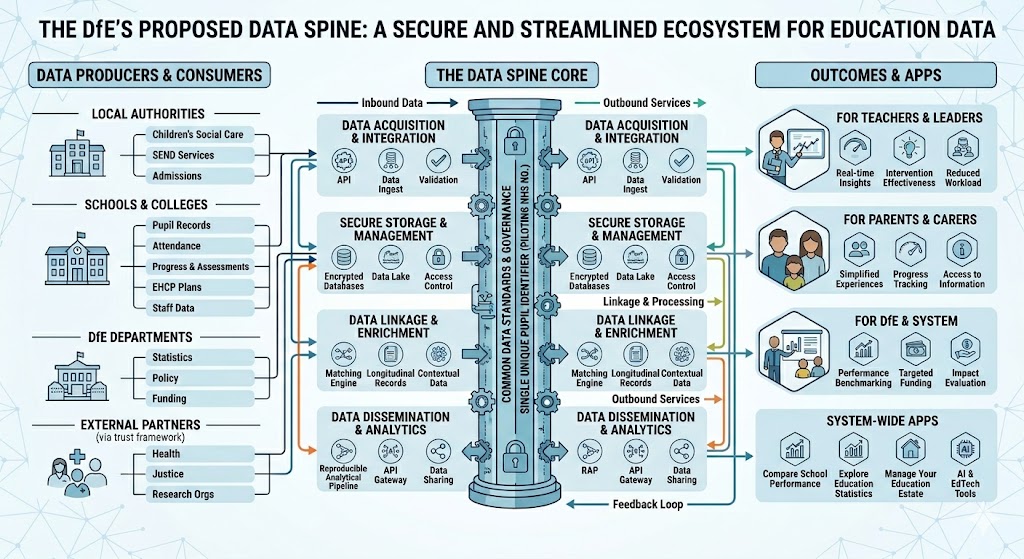
There was also considerable discussion around the Department for Education’s developing data spine initiative and what it may mean for the future of school data management.
While details continue to evolve, many leaders appear increasingly interested in the potential for greater interoperability between systems and the possibility of reducing dependency on closed ecosystems.
For some schools, this raises important questions about future-proofing technology decisions made today. For suppliers, it may signal a gradual shift toward more open and connected data environments across education.
Although it remains early in the process, it is clear that the direction of travel around data accessibility, integration and interoperability is becoming an important strategic consideration.
A More Mature MIS Market
Perhaps the clearest takeaway from this year’s show was that the MIS market continues to mature.
Schools are no longer simply asking “Which system is best?”
Instead, they are asking:
- Which solution best aligns with our long-term strategy?
- Which supplier relationship gives us confidence?
- How do we avoid over-dependence?
- What level of flexibility will we need in future?
- How do we ensure successful implementation and adoption?
These are exactly the kinds of questions that independent advice and structured procurement processes are designed to support.
What stood out most at this year’s show was the quality of the conversation. Schools and trusts are approaching MIS decisions with greater confidence, asking more strategic questions about resilience, interoperability and long-term fit.
That shift reflects a more mature market — one in which technology choices are increasingly shaped not just by features, but by flexibility, control and long-term strategic value.
Press Release

Received on 12 May 2026 from VenturEd Solutions. The following content is reproduced as a vendor press release and is separate from the editorial analysis above
New safeguarding framework helps schools act quickly to keep students safe
VenturEd Solutions launches new approach at the Schools & Academies Show

12th May 2026 – Staff in schools make safeguarding decisions every day, often with limited time and incomplete information. Vital details about students are often recorded across multiple systems for safeguarding, medical needs, behaviour and attendance. However, because these systems operate separately, there is a risk that important information could be missed.
To address this, VenturEd Solutions launched a new safeguarding framework at the Schools & Academies Show last week, at the Schools & Academies Show at Excel London. The framework brings together safeguarding records held in CPOMS StudentSafe, alongside supporting data from Medical Tracker and SchoolPod, to help surface relevant information across systems so staff can identify important links sooner and act quickly when something doesn’t seem right.
In a busy school day, a class teacher might record a behaviour incident, a TA may log medication that a child needs to take, and the DSL might add a safeguarding note. On their own, none of these updates might be anything to note. But together, they could highlight a student who needs support.
For example, a student may be missing more school, be visiting the medical room more often with headaches or stomach aches and showing a change in behaviour such as becoming withdrawn or more anxious in class. Each of these could be easy to explain. But when you look at them all together, they could give safeguarding staff a clearer picture to step in early and help.
Ed Farmilo, former teacher and senior leader at VenturEd Solutions, said: “Safeguarding decisions are rarely based on one big incident. It’s usually small things that start to add up like a change in behaviour, more visits to the school office for medical advice or a student’s attendance starting to dip.
“The challenge is having the ability to spot those patterns early. Our aim is to make that easier for schools, so they can act sooner when something isn’t right.”
Daniel Neeld, managing director at Medical Tracker, said: “Schools have always held the pieces of the puzzle, but too often health sits in one system, safeguarding in another and behaviour somewhere else. By bringing Medical Tracker, CPOMS and VenturEd Solutions together in this framework, we’re giving schools the complete picture of every child, built from specialist tools that each do their job brilliantly. That’s how you move from reacting to concerns to getting ahead of them.”
Rick Gardner, managing director at CPOMS, added: “The new framework builds on systems schools already use. It doesn’t add extra workload or require staff to learn something new. It simply helps the systems share relevant information so safeguarding teams can see the full picture and respond more quickly.”
Call-to-Action:
➡ Read our guide at WhichMIS
➡ Or book a free, no-obligation consultation
hello@whichmis.com